

The app-store illusion
For millions of informal workers across Southeast Asia, formal credit has one consistent answer: no. No bank account history. No payslips from a registered employer. No credit file anywhere a normal lender can read it.
The need for money does not disappear with the rejection. So borrowers go looking for whoever will say yes. In the Philippines right now, whoever says yes first is very often an app: cheap to build, fast to approve, and designed around a very different definition of collateral than the one printed in any lending contract.
Open the iOS App Store and search for Philippine loan apps. You will find bright icons, friendly names, fast approvals, low barriers, and easy language about financial freedom. The design communicates safety. In many cases, the substance does not.
A review of 40 online lending applications active in the Philippines found that only 25% were registered with the Securities and Exchange Commission. Of those claiming to report credit scores, most were not listed with the Credit Information Corporation of the Philippines, the official body that exists specifically to make borrower records portable and useful.
This is not a niche problem. The National Privacy Commission has received hundreds of formal complaints against online lending apps, all reporting essentially the same pattern: contact lists accessed without genuine consent, personal information disclosed to third parties, and harassment aimed not only at the borrower but at family members, coworkers, and friends.
Who is actually running these apps
The ownership structure of Philippine online lending apps is one of the most revealing parts of the story, and the least discussed. Research into the operators behind iOS-listed loan apps finds a consistent pattern: many are registered under one company name in the SEC while operating three or four different app brands at the same time.
A single lending corporation may run several consumer-facing products with shared infrastructure and ownership. If one brand accumulates too many complaints or regulatory attention, the others continue operating.
The nationality breakdown of identified operators skews heavily toward Chinese nationals, often in partnership with Filipino co-directors who provide the local registration requirements. This is not uniformly predatory. Legitimate Chinese-backed fintech operates across Southeast Asia. But it does create accountability gaps when abusive collection tactics have to be traced through local registrations, offshore operators, and app-store listings that can be changed or removed.
HappyCash, operated by Yinshan Lending Inc., lists a CEO profile on LinkedIn. The company is SEC-registered, but it is not listed with the Credit Information Corporation. The executive profile raises credibility questions: the profile photo appears AI-generated, the account has no meaningful independent footprint, and searches did not surface a matching public professional record outside the profile itself.
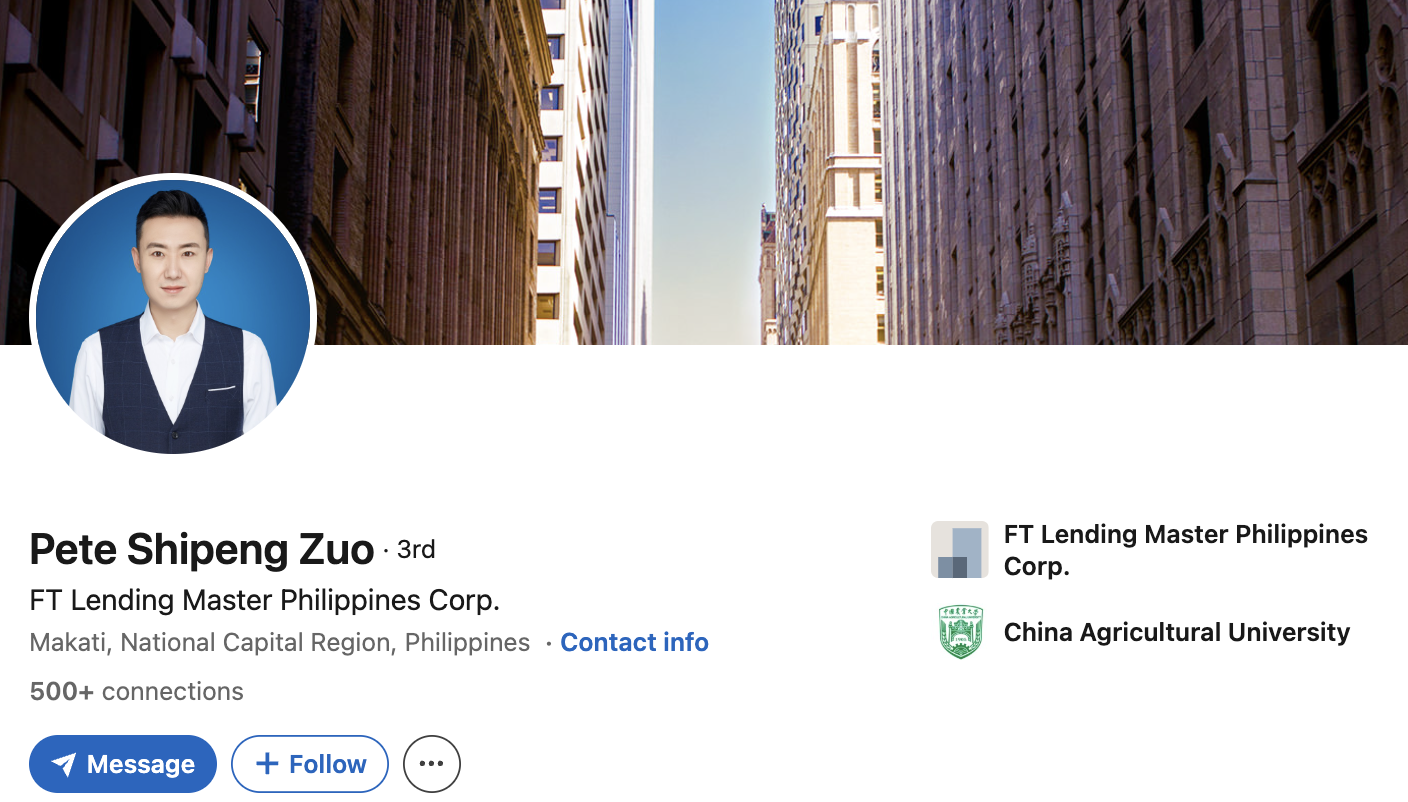
FT Lending similarly presents a LinkedIn executive identity with a highly polished portrait, a generic corporate-style background, and little verifiable external presence. Researchers were unable to find normal public traces one would expect from a real executive operating a consumer lending company: no press mentions, no visible industry history, no independent references, and no credible trail beyond the profile.

Constructed credibility
The two profiles are especially striking side by side. They come from different companies, yet use the same credibility formula: clean studio-like profile photo, generic city cover image, executive title, university badge, and almost no discoverable life outside the page.
The profile photos are not proof by themselves. But in context, they are a red flag. They look less like accidental placeholders and more like constructed credibility: the visual language of a legitimate fintech executive used to project trust to borrowers, regulators, and journalists who might only do a surface-level check.
The pattern is not limited to corporate profiles. A Cashify video on Facebook reportedly showed roughly 61,000 views with not a single comment. That is not impossible, but it is suspicious for a consumer loan product targeting real borrowers. Real financial products generate questions, complaints, reactions, confusion, spam, tags, anger, and support requests.
A large-view, zero-comment lending video deserves scrutiny because it suggests the visible engagement layer may be managed, suppressed, inflated, or disconnected from genuine borrower activity.
The point is not that every odd profile photo or quiet Facebook video proves fraud. The point is that these apps often rely on surfaces of legitimacy that collapse under basic verification. The App Store listing looks safe. The LinkedIn identity looks professional. The video looks popular. But when the company is not CIC-listed, the executive identity cannot be independently corroborated, the profile image appears synthetic, and borrower complaints describe contact-list abuse, the surface is doing a lot of work.
The contact list is the product
To understand what these apps are actually selling, you have to understand what they are actually collecting. When a borrower downloads a loan app and requests a small amount, maybe PHP 2,000, PHP 5,000, or an emergency float, they are typically asked for permissions that have nothing to do with assessing their ability to repay.
Contacts. Location. SMS history. Camera. Sometimes social media access. The framing is underwriting: we need to assess your risk profile. The function is leverage: we need to know who to call if you are late.
The National Privacy Commission documented the mechanism precisely in its complaints: contact lists are accessed without genuine consent or authority, and the information is used to send threatening, false, or humiliating messages to people who never agreed to be part of a loan transaction. The borrower thinks they borrowed money. The lender knows they purchased leverage over a social network.
Who borrows, and why they stay
The typical Philippine online lending app borrower does not look like someone making a careless financial decision. Research from Tala paints a specific profile: young adults, 25-34, predominantly female, urban, some college education, Android smartphone users with household incomes under PHP 42,000 a month supporting 2-6 family members.
They borrow primarily for emergency expenses, bill payments, and daily needs. Nearly 90% report clear awareness of interest rates and fees at the point of application. They are not confused about the terms. They are choosing the available option.
The Philippine financial literacy rate sits at approximately 25% of adults, 13th among 21 developing Asian countries in a recent comparative ranking. But low financial literacy is not what drives online lending app use. High financial exclusion is. A borrower who understands exactly what an app charges and takes it anyway is telling you something about the alternatives, not about their comprehension.
What keeps borrowers inside the system is not ignorance. It is the absence of a portable exit. A borrower who repays an app on time has demonstrated something real. But if the lender is not CIC-registered, that demonstration produces no transferable credit record. The next emergency starts from zero. The same gate is still the only open one.
The first record becomes the story
There is a simple principle underneath all of this. The first lender to say yes to a new borrower gets to write the first entry in their financial story. If that entry is written by a legitimate lender into a system the borrower owns and can carry forward, it becomes a ladder. If it is written by a predatory app into a private database that serves the lender collection function rather than the borrower future access, it becomes a trap.
The borrower repays. The lender learned something valuable about that borrower. The borrower behavior generated a proof of reliability. The borrower does not own that proof. It does not travel with them. The next lender cannot see it. The system resets.
This is how predatory credit reproduces itself. It is not primarily about interest rates, though the rates are often abusive. It is about who owns the useful output of a completed loan. A repayment is evidence. Evidence should belong to the person who produced it.
What a different pipe looks like
The OLA problem in the Philippines is a specific, documentable instance of a structural failure in credit infrastructure. Informal workers need access to liquidity. Formal systems exclude them. Shadow systems rush in, and the shadow systems are designed around the logic of leverage, not the logic of underwriting.
A fair alternative has to be different in structure, not just in tone. Friendlier copy and brighter colors are not a product. Predatory apps already know how to look friendly: the app names, the fast-approval UX, the polished LinkedIn profiles, the synthetic-looking executive photos, the engagement numbers that do not behave like real communities, and the trust-building flow that arrives before the permissions request.
The structural differences that matter are simple: no contact-list collateral, terms before funding, identity that protects the network without exposing the person, and repayment history that belongs to the borrower.
The first credit record should be a ladder. Moodeng is designed around that premise: small USDC loans, World ID verification, and portable repayment history for borrowers building credit where the formal system has not reached them yet. The app that says yes first should not get to own your financial story forever.